Sept. 11 Southwestern chapel marked by prayer, worship panel discussion
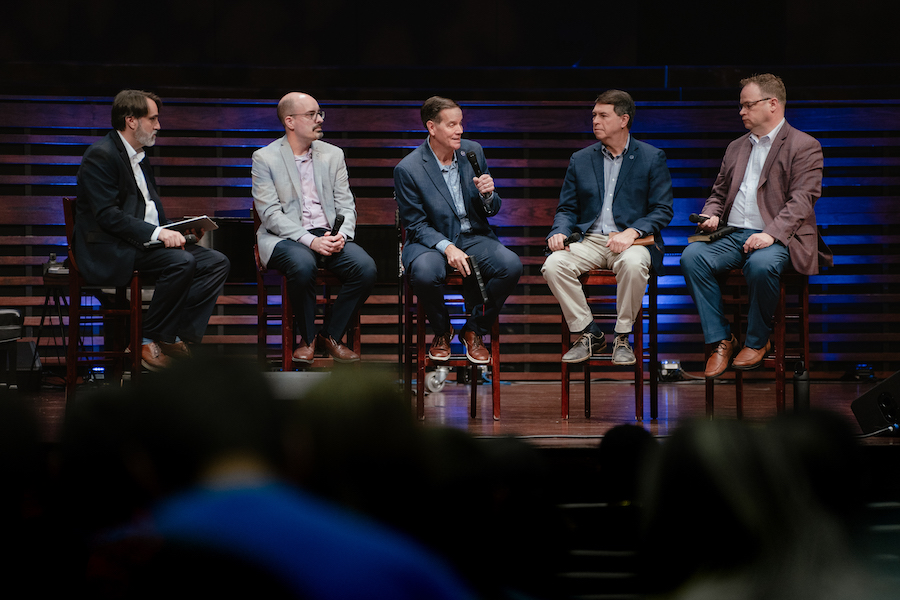
A faculty panel from the School of Church Music and Worship (SCMW) at Southwestern Baptist Theological Seminary spoke about worship as a “multi-faceted jewel” and “transformational,” during the seminary’s Sept. 11 chapel service.
Seminary President David S. Dockery struck a somber note in his welcoming remarks, saying Sept. 11 is “a day that has been marked on our calendars now for 24 years in this country.” Recalling the 2001 terrorist attacks on America, Dockery said that day brought “a cataclysmic event that is ingrained in our conscious as a nation forever.”
He urged people to gather together and pray due to recent events as well, noting school shootings in the United States, global conflicts, and the previous day’s assassination of Charlie Kirk, a Christian conservative political leader, while speaking at an event at Utah Valley University in Orem, Utah.
Dockery pointed out a social media post made by Kirk’s wife, Erika, from the same day that her husband would be killed, quoting Psalm 46:1: “God is our refuge and strength, a helper who is always found in times of trouble. Therefore we will not be afraid, though the earth trembles and the mountains topple into the depths of the sea.”
Dockery encouraged the audience to trust in God and recognize that “in the midst of injustice on the earth, we don’t have answers. We turn to the Lord who, in His marvelous providence, eventually turns those things meant for evil into redemptive good.”
As the panel discussion got underway, Provost W. Madison Grace II questioned SCMW faculty on a wide range of topics ranging from Scripture-guided worship to times music creates a hindrance to the congregation and more. Panelists included Joseph Crider, dean; Charles Lewis, Jr., associate dean; Nathan Burggraff, associate professor of music theory; and Bennie Caston Jr., professor of voice. Grace noted the men are not just academics—they also serve in their respective churches.
In response to a question about his philosophy of worship, Crider said people tend to equate music with worship, “so therefore, the whole idea of worship is relegated to a musical expression. Obviously, music is very important and a gift of God to us, but to relegate it to that really diminishes it.” He called worship “a multi-faceted jewel,” adding, “It’s not just a reality of life, it’s the reality of life.”
Asked by Grace to define “liturgy,” Lewis said it’s “just a fancy word for order of service.” He said the word “liturgical” is more formal, adding “it begins to describe a shape and an arc of the service itself.” He said services that are planned intentionally might follow “the Isaiah 6 model,” which takes the congregation from revelation to adoration to confession, then to a place of thanksgiving, supplication, proclamation, and finally to benediction.
“Ultimately, worship is transformational, it is discipling, it is shaping the hearts of the worshipers,” Lewis said. “It’s not a mandate that we have to follow this pattern, but it is an example of a biblical way in which we construct a biblical liturgy or order of service.”
In describing the role artistry in music plays in worship, Caston referred to Psalm 33:3, which says to play skillfully.
“Musicianship takes time to build,” he said. “It’s not something we can go through the drive-thru and get a combo deal on. It takes time.”
If God has called believers to do something, He doesn’t want them to do it halfway, Caston said, adding that if they dedicate themselves to becoming the best keyboardist, singer, etc., “then you understand it’s going to cost you something.”
Burggraff spoke of research he has conducted on the songs that are currently sung in American evangelical churches. He noted that songs from the 1990s had a “shelf life” of about 12 years in churches, adding they would be popular for four or five years, then slowly decline. Songs written after 2010 had a shelf life of about three to four years, he said.
He said many songs in churches today are written for a solo voice and don’t really work well for communal singing. The vocal range of some songs is also higher, he said, making it hard for some people to sing those songs. Combining those two elements, he said, “we’re actually creating congregational hindrance, as opposed to congregational participation. And taking that with a shorter shelf life, this is a recipe for just not having actually anything to sing that we actually remember and then can sing.”
In a lighter moment, Grace referred to mishaps that occur in the life of any music leader and asked Lewis to explain a “rumor” about him and a camel. Lewis said he previously served at First Baptist Church in West Palm Beach, Fla., and had the idea of including animals in the church’s musical presentation for Christmas. The camel fell into the congregation during dress rehearsal, he said, adding that some college students caught the whole thing on their cellphones. The video went viral, drawing national media attention, he said, adding the video is still available on YouTube.
Following additional discussion of the seminary’s Doctor of Musical Arts program, the role of a music leader in a church, and the principles of worship, Grace asked Crider to define what a benediction is and then lead the audience in one.
“The primary focus of a benediction is really an articulation of a blessing,” along with a charge to live in a manner worthy of the Gospel, Crider said before reading Ephesians 3:21-22 and leading the audience in a song of praise.
See the entire panel discussion here.
Chapel is held every Tuesday and Thursday morning at 11 a.m. (CT) in MacGorman Chapel on the campus of Southwestern Seminary and Texas Baptist College. Chapel may be viewed live at swbts.live.