
Professional Doctoral Studies (DMin and DEdMin)
Professional Doctoral Studies
Doctor of Ministry (DMin) and Doctor of Educational Ministry (DEdMin)
Forming humble servant-leaders for the global church.
Combining academic excellence with ministry application, these degrees develop expert ministers who exhibit not only ministry competence but also godly character.
Degree Highlights
- Program Cost:
- DEdMin: $2,630 per semester (review all tuition and fees)
- DWS: $2,630 per semester (review all tuition and fees)
- DMin: $2,100 per semester (review all tuition and fees)
- 12 concentrations available
- Complete in 3 years (6 semesters)
- Four seminars over years 1-2, while year 3 is devoted to final project
Our vision is to form humble servant-leaders for the global Church. The purpose of Professional Doctoral Studies at Southwestern Baptist Theological Seminary is to develop reflective and expert practitioners in ministry who will grow not only in ministry comprehension and competence but also in character and virtue. Because it is a doctoral degree program, the student is expected to pursue a high standard of expertise in ministry reflection and practice.
Students will be challenged to think biblically and critically about the work of ministry and to articulate and demonstrate a thorough biblical and theological vision for ministry practice. When students graduate, they can be confident that they have achieved a level of excellence in their area of study and have been equipped for more effective ministry leadership.
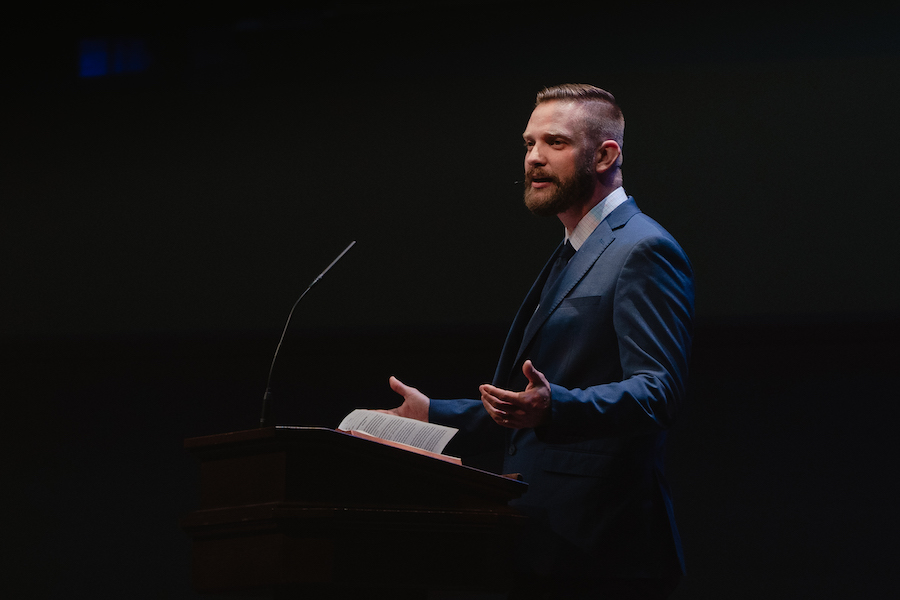
Which doctoral degree is right for you?
Available Concentrations
Students in both the DMin and DEdMin can choose from one of the following concentrations for their program:
The concentration in Text-Driven Preaching is designed to train pastors and church leaders for more effective exegesis of Scripture for the purpose of sound teaching and faithful preaching and to understand the historical significance of Text-Driven Preaching.
Seminars:
- Introduction to Text-Driven Preaching
- Preaching the Old Testament
- Preaching the New Testament
- Great Preachers & Their Preaching
Seminar Professors: Matthew McKellar & Chris Osborne
Basic Bibliography:
- Text-Driven Preaching edited by Akin, Allen and Mathews
- The Art of Preaching Old Testament Narratives by Steven Mathewson
- Recapturing the Voice of God by Steven Smith
- Preaching and Preachers by D. Martyn Lloyd-Jones
- Biblical Preaching by Haddon Robinson
- The Supremacy of God in Preaching by John Piper
- Privilege the Text by Abraham Kuruvilla
- Christ-Centered Preaching by Bryan Chapell
The concentration in Pastoral Theology is designed to equip pastors to be faithful shepherds and effective church leaders through the critical reflection of the biblical, theological, and historical foundations for pastoral ministry.
Seminars:
- Biblical & Theological Foundations for Pastoral Leadership
- History & Practice of Pastoral Care
- Theology of Church Membership & Polity
- Pastoral Theology & Leadership
Seminar Professors: Todd Pylant, Matthew McKellar, & Chris Osborne
Basic Bibliography:
- Baxter, Richard. The Reformed Pastor
- Bucer, Martin. Concerning the True Care of Souls.
- Ford, Coleman and Shawn J. Wilhite. Ancient Wisdom for the Care of Souls: Learning Pastoral Ministry from the Church Fathers.
- Gregory the Great. The Book of Pastoral Rule
- Martyn Lloyd-Jones, Preaching and Preachers
- Matt McCollough. Remembering Death
- Derek Prime. Pastors and Teachers: The Calling and Work of Christ’s Ministers
- Tripp, Paul. Lead: 12 Gospel Principles for Leadership in the Church
The concentration in Apologetics is designed to assess the biblical, theological, philosophical, and historical foundations of apologetics in order to equip students to become effective evangelists and disciple-makers for the church.
Seminars:
- DMNAP6014 Biblical and Theological Foundations for Apologetics
- DMNAP6024 Defense of the Bible and Resurrection
- DMNAP6034 The Problem of Evil and Religious Pluralism
- DMNAP6044 Evolution and Creation
Seminar Professors: Andrew Jennings & Ted Cabal
Basic Bibliography:
- Jesus and the Eyewitnesses by Richard Bauckham
- Controversy of the Ages by Theodore Cabal
- Contending with Christianity’s Critics by Paul Copan and William Lane Craig
- Reasonable Faithby William Lane Craig
- A History of Apologeticsby Avery Dulles
- Christian Apologetics Past & Present1–2 ed. by William Edgar and K. Scott Oliphant
- Jesus before the Gospels by Bart Ehrman
- The Gospel after Christendom: An Introduction to Cultural Apologetics by Collin Hansen, Skyler Flowers, and Ivan Mesa
- Mere Christianityby C. S. Lewis
- Miracles by C. S. Lewis
- The Problem of Pain by C. S. Lewis
- Mapping Apologeticsby Brian Morley
- Dissonant Voicesby Harold Netland
- The Problem of Evil by Michael Peterson
- He Is There and He Is Not Silentby Francis Schaeffer
- The Universe Next Door(6th ed.) by James Sire
- The Problem of Divine Hiddenness by J. L. Schellenberg
The concentration in Evangelism and Missions is designed to critically engage the biblical, theological, historical, and socio-cultural bases of evangelism and missions to prepare you academically and professionally for effective Great Commission leadership.
Seminars:
- Theology of Missions and Evangelism
- History of Evangelism & Missions
- Anthropology & Contextualization in Missions & Evangelism
- Ecclesiastical Factors in Evangelism & Missions
Seminar Professors: Mike Morris, Kevin Rogers, & John Bitar
Basic Bibliography:
- David Hesselgrave and Keith Eitel, eds. Paradigms in Conflict: 15 Key Questions in Christian Missions Today.
- Moreau, Scott. Contextualization in World Missions: Mapping and Assessing Evangelical Models.
- Ott, Craig, Timothy C. Tennent, and Stephen J. Strauss. Encountering Theology of Mission: Biblical Foundations, Historical Developments, and Contemporary Issues.
- Coleman, Robert E. The Master Plan of Evangelism.
- McDow, Malcolm and Alvin L. Reid. Firefall 2.0: How God Has Shaped History Through Revivals.
- McCloskey, Mark. Tell It Often-Tell It Well.
- Beougher, Timothy K. Invitation to Evangelism: Sharing the Gospel with Compassion and Conviction.
- Green, Michael. Evangelism Through the Local Church: A Comprehensive Guide to All Aspects of Evangelism.
The concentration will explore the role of the church planting leader in nurturing, guiding, and deploying the church planter and church planting team. The courses also highlight the importance of effective relationships between the catalyst, church planter, denominational agencies, and partner churches in the planting process.
Seminars:
- Church Planting Leadership
- Church Planting & Personal Soul Care
- North American Methodology & Church Planting
- Methods & Models of International Church Planting
Seminar Professors: Mike Morris & Mark Terry
Basic Bibliography:
- Hesselgrave, David F. Planting Churches Cross-Culturally: North America and Beyond.
- Searcy, Nelson and Kerrick Thomas, Launch: Starting a New Church From Scratch.
- Stetzer, Ed and Daniel Im, Planting Missional Churches: Your Guide to Starting Churches that Multiply.
- Tripp, Paul David. Lead: 12 Gospel Principles for Leadership in the Church.
- Groeschel, Craig. Lead Like It Matters: 7 Leadership Principles for a Church That Lasts.
- Willard, Dallas. The Divine Conspiracy.
- McIntosh, Gary L. Overcoming the Dark Side of Leadership.
The concentration in Biblical Counseling is designed to critically evaluate counseling methodology and models, current issues in biblical counseling, and biblical and theological foundations of counseling ministry to effectively counsel the Word in a wide array of ministry contexts.
Seminars:
- Foundations in Counseling Ministry
- Counseling Methodology: Historical & Contemporary
- Practical Application & Strategies in Biblical Counseling
- Critical Issues in Counseling
Seminar Professors: Jonathan Okinaga & Lilly Park
Basic Bibliography:
- Adams, Jay. Competent to Counsel
- Borgman, Brian. Feelings and Faith: Cultivating Godly Emotions in the Christian Life
- Emlet, Michael. Descriptions and Prescriptions
- Lambert, Heath. The Biblical Counseling Movement after Adams
- Lambert, Heath. The Theology of Biblical Counseling
- McArthur, John. Counseling: How to Counsel Biblically
- Powlison, David. Seeing with New Eyes
- Tripp, Paul. How People Change
The concentration in Family Ministry is designed to equip ministry leaders with the biblical, theological, historical, and sociological framework for effective application of family ministry practices in the local church and other ministry contexts.
Seminars:
- Theological Foundations for Family Ministry
- Family Ministry Models & Practice
- Biblical Response to Issues in Children’s Ministry
- Biblical Response to Issues in Student Ministry
Seminar Professors: Chris Shirley, Karen Kennemur, & Richard Ross
Basic Bibliography:
- Anthony, Michael and Michelle Anthony eds. A Theology for Family Ministry.
- Hunter, Ron. Recalibrate: A New Measure for Family Ministry.
- Jones, Timothy Paul and Randy Stinson. Trained in the Fear of God: Family Ministry in Theological, Historical, and Practical Perspective.
- Jones, Timothy Paul (Ed.). Perspectives on Family Ministry: Three Views, 2nd Edition.
- Jones, Timothy Paul. Family Ministry Field Guide: How Your Church Can Equip Parents to Make Disciples.
- Köstenberger, Andreas with David W. Jones. Marriage and the Family: Biblical Essentials.
- Rienow, Rob. Visionary Church: How Your Church Can Strengthen Families.
- Shirley, Chris. Family Ministry and the Church: A Leader’s Guide for Ministry through Families.
The concentration in Discipleship and Christian Growth is designed to critically engage in the biblical and theological basis for discipleship as well as the historical practice of disciple-making for more effective leadership in multiple ministry contexts.
Seminars:
- Biblical & Theological Foundations for Discipleship
- Discipleship in Context: Sociological & Developmental Considerations
- Disciple Making Models & Practices in the Local Church
- Current Issues & Opportunities in Disciple Making
Seminar Professors: Chris Shirley
Basic Bibliography:
- Following the Master - Michael Wilkins
- Discipleship and Conversion - Bill Hull
- The Trellis and the Vine - Collin Marshall and Tony Payne
- Spiritual Formation as if the Church Mattered - James Wilhoit
- The Cost of Discipleship - Dietrich Bonhoeffer
- Strategic Disciple Making - Aubrey Malphurs
- The Lost Art of Disciple Making - Leroy Eims
- Spiritual Multiplication in the Real World - Bob McNabb
- Deep Discipleship - J.T. English
- Why the Gospel? - Matthew Bates
The concentration in leadership equips ministry leaders with the biblical, theological, and practical foundations needed to lead with integrity and effectiveness in today's church and Christian ministry. Students develop a theologically informed leadership philosophy while building skills in personal leadership formation, team development, and strategic ministry planning.
Seminars:
- Theological Foundations for Christian Leadership
- Personal Leadership Development
- Leadership Development in Others
- Strategic Church Leadership
Seminar Professors: Shane Parker, Terri Stovall, & Jonathan Teagu
Basic Bibliography:
- The Leadership Challenge by James M. Kouzes and Barry Z. Posner
- Leadership on the Line by Ronald A. Heifetz and Marty Linsky
- The 6 Types of Working Genius by Patrick Lencioni
- Leading Change by John P. Kotter
- Spiritual Leadership by Henry and Richard Blackaby
- Lead: 12 Gospel Principles for Leadership in the Church by Paul David Tripp
- The Making of a Leader: Recognizing the Lessons and Stages of Leadership Development by Dr. J. Robert Clinton
- Jesus on Leadership by C. Gene Wilkes
- The Vision Driven Leader by Michael Hyatt
- At Your Best by Carey Nieuwhof
- Biblical Leadership: Theology for the Everyday Leader, by Benjamin Forrest & Chet RodenLeadership in Christiain Perspective: Biblical and Contemporary Practices for Servant Leadersby Justin Irving and Mark Strauss
- Authority in the Church: Exploring the Roles of Congregation, Elder and Deacons, by Benjamin Merkle
- Spiritual Leadershipby Oswald Sanders
- Ethics for Christian Ministry: Moral Formation for the Twenty-First Century Churchby Joe Trull and Robert Creek
Entrance Requirements
Prospective students seeking to apply should complete the online admissions application at www.swbts.edu/applynow. Additional information can be requested from the Office of Professional Doctoral Studies by phone at 817.923.1921, ext. 6700, or by email at [email protected] for DMin students and [email protected] for DEdMin students.
Students may apply at any time of the year. The seminar cycle begins in the fall semester so students are encouraged to complete the application process no later than May 1. This timing will ensure that students can enroll in and complete the online research and writing courses before their concentration seminars begin.
- An earned MDiv degree (72-hours) or equivalent from an accredited institution.
- A 3.0 grade point average or above on a 4.0 scale for all graduate-level studies.
- Significant ministry experience demonstrated through a ministry résumé.
- An earned Master of Arts in Christian Education (MACE) degree (68-hours) or equivalent from an accredited institution.
- A 3.0 grade point average or above on a 4.0 scale for all graduate-level studies.
- Significant ministry experience demonstrated through a ministry resume.
- Ministry Employment: Applicants must be employed in vocational Christian ministry during the time they are enrolled in the degree. Exceptions can be made for special circumstances, such as missionaries on furlough or international students who will be returning to their home countries to complete the doctoral project.
- Background Check: Applicants must complete a background check through the Admissions Office.
- Transcripts: Transcripts from undergraduate and graduate degrees.
- References: Two (2) Confidential Reference forms, one academic and one personal. The academic form must be completed by a professor from whom applicants have completed a graduate level course. The professor must have an earned doctorate degree from an accredited institution.
- Statement of Ministry Endorsement form
- Current ministry resume
- A 3-5 page “History of Ministry-Related Experience.” This paper should note specific ministry responsibilities, significant relationships, influential works, and spiritual insights gained from them. It should also include how the specific concentration that students are applying to will enhance their current ministry practice.
Applicants must be approved for general seminary admission prior to consideration by the Professional Doctoral Office. Any former Southwestern student wanting to return for additional studies is asked to complete a re-admission process. An applicant who has not previously attended Southwestern Seminary should comply with current admission standards. Exceptions to any admission requirements must be approved by the Professional Doctoral Studies office prior to the student’s acceptance and enrollment. Due to the institution’s doctrinal convictions, only male students will be considered for Pastoral Theology and Text-Driven Preaching majors in the Doctor of Ministry program.
Those applicants who have not completed an MDiv or ATS approved Master of Arts degree, but have completed another type of Master’s degree, must contact the Professional Doctoral Office to request a transcript evaluation. Some applicants may need to complete leveling work before their Master’s degree can be considered equivalent to the MDiv or Master of Arts degree. Please note that all leveling work must be completed before students can begin seminars.
- Complete all the steps listed above for the normal application process
- A transcript from an international institution will require certification to demonstrate its equivalence to graduate-level work in the United States. International applicants must contact and submit their transcripts to SpanTran (www.spantran.com; 2400 Augusta Drive, Suite 451, Houston, TX 77057; 713.266.8805; fax: 713.789.6022) for evaluation. The evaluation service sends evaluation results directly to the Office of Admissions.
-
International applicants must submit scores from the TOEFL (Test of English as a Foreign Language) or IELTS. For the TOEFL, a score of 5-6 (maximum score of 6) is required. Students who complete the computer-based TOEFL must also complete the TSE (Test of Spoken English). IELTS language exam requires a score of a 7. Southwestern Seminary and Texas Baptist College will no longer accept Duolingo as an entrance language exam. Students may continue to submit test scores from TEOFL or IELTS.
-
International applicants where English is a recognized official language or graduated from a US institution with an accredited Master’s degree may apply for a waiver for the English Proficiency requirement. The International Student Services Office and/or reserves the right to require an English proficiency test in cases where language deficiencies are found to exist even though a waiver could be granted.
An applicant from outside the United States must meet U.S. Department of Homeland Security (DHS) regulations to study at Southwestern Seminary in any program. Any approval of the applicant’s admission to the DMin Program is contingent upon the applicant maintaining proper status. Southwestern Seminary’s International Student Services Office communicates regularly with the DMin Program to assure that all DHS regulations are followed.
Acceptance
Applicants will be notified of the final decision on their application in writing by the Professional Doctoral Office. Upon acceptance into the program, the Professional Doctoral Office will send a letter of acceptance as well as information pertaining to registration and other necessary program details.
Denial of Admission
Applicants who are denied admission, and who wish to reapply, must wait at least one year before doing so. All requirements not previously met must be satisfied before admission is possible.
Entry Deferment
Those students who are approved to begin the DMin or DEdMin Program may delay initial seminars up to a maximum of one year by submitting a formal petition to the Director of Professional Doctoral Studies for approval. After this one-year period, students must submit a written request to begin the program, along with an explanation of the changes in circumstances which will permit the student to pursue the DMin or DEdMin degree.
Program Structure and Timeline
The Professional Doctoral Program at Southwestern presents a unique design intended to provide excellent instruction and distinct Christian formation while maintaining flexibility within a student’s ministry context. Thus, the program can be broken down into three major components 1) annual seminars, 2) guided discussions, and 3) ministry coaching. Additionally, students begin the writing process for their doctoral project soon after acceptance by means of two online seminars. These seminars are intended to acclimate the student to doctoral research and writing and the mechanics of the Ministry Research Project. The Ministry Research Project represents the culmination of their professional doctoral work. The doctoral cycle takes place as follows:
YEARS 1-2
Acceptance and Enrollment
Introduction to Research & Writing
4 wks online
Contextualized Ministry Leadership
4 wks online
Students will also work on their project proposal in two stages, and a project supervisor will be assigned.
Fall Semester
Sept-Dec
LiveSync Guided Discussions
Monthly, Sept-Nov
Seminar 1 Assignments
Individual Coaching
Sept & Dec
January
Annual Southwestern Seminar
Seminar 1 OR 3 (Mon-Wed) Seminar 2 OR 4 (Thurs-Sat)
Chapel
Equipping Lunch
Fort Worth Experience
Spring Semester
Feb-May
LiveSync Guided Discussions
Monthly, Feb-April
Seminar 2 Assignments
Individual Coaching
Feb & May
June-Aug
Contextualized Writing
Chapters 1-2 (Year One)
Chapters 3-4 (Year Two)
YEAR THREE
Sept-Mar
Project Conclusion
Oral Defense
May
Graduation
Doctoral Ceremony
ANNUAL SEMINAR WEEK SCHEDULE
Mon-Wed
M-Tu (8:00am-5:00pm)
W (8:00am-11:00am)
Foundational Seminar 1 (Year One)
OR Foundational Seminar 3 (Year Two)
Wed-Fri
W (1:00pm-5:00pm)
Th-F (8:00am-5:00pm)
Foundational Seminar 2 (Year One)
OR Foundational Seminar 4 (Year Two)
The DMin and DEdMin can be completed in 3 years, but the maximum time allotted is 6 years. Students who extend their program beyond six years must submit an annual written request to the Office of Professional Doctoral Studies to extend their program.
Got Questions?
We’re here to answer them. Reach out to our Admissions Team and we’ll be in touch by phone, text, or email.