
From Mergers and Money to Ministry and Multiplying

Ryan Lee follows God’s calling away from the business world to ministry at Semihan Church
Editor’s Note: The following article originally appeared in the spring 2026 issue of Southwestern News.
When Ryan Lee was born in Korea, doctors told his parents the sickly infant would not survive past his first weeks and months of life. Lee’s mother, who was banned from attending church by her husband because his family were firm followers of Shamanism, sought out a Christian pastor to pray for her son.
Billy Kim, pastor of Central Baptist Church in Suwon who served as an interpreter for Billy Graham and would later be the president of the Baptist World Alliance, received her request but had to decline because he was about to fly out of the country. But Lee says Kim arrived at the airport to find his flight had been canceled and immediately went to the hospital instead.
Lee’s paternal family did not allow the pastor access to the hospital room, even when the doctors had said he had just days to live. Lee says his grandmother had instead purchased numerous paper talismans for the hospital room, sometimes worth thousands of dollars, to try to remove the evil spirits that might be causing his illness.
Kim and Lee’s mother prayed for hours in the hallway outside.
“All of a sudden, he asked, ‘If he survives, if he’s well, will you commit him to God’s ministry? Kingdom ministry?’” Lee says of that conversation Kim had with his mother. “’Will you give him to the Lord so that He can use him for the greater Kingdom?’”
Lee says his mother responded with an affirmative. Two days later, Lee was sent home completely healthy.
That “miraculous healing” created a trajectory in Lee’s life leading towards ministry, though he at times did not realize the extent of that calling.
The answered prayers for Lee’s healing had immediate results in his family, as he and his sister and mother were now allowed to attend church and he went to a Christian academy for his early education.
“That was the beginning of our faith journey,” Lee says, saying he spent his school breaks copying by hand the entire Bible and memorizing Scripture. “… I had very good faith, and I had no doubt that I’ll become a missionary pastor because God saved me, and my mother continuously told me that ‘God saved you and you have to be a servant of God.’ That memory, that kind of conversation has always been in my life.’”
Being raised in the faith and with that expectation, Lee says he went through middle school as a good student, explaining that in Asian culture students are not graded with a letter system like in Western cultures, but based on rank compared to the other students in the school, the city, and even the entire region.
Lee says he was always ranked in the single digits among his peers, so his mother asked him if he would be interested in going to a more prestigious school in Seoul for his high school years. Lee explains that is where successful students are usually sent to complete their studies in Korea.
Lee attended Daewon Foreign Language High School in Seoul, where he says he had a completely new experience as many of his peers now came from affluent families involved in conglomerates such as Samsung and LG or were children of professors and other influential individuals and were already bilingual and even trilingual.
“I was from an ordinary family back in Suwon,” Lee says of his high school experience, adding that suddenly he was no longer ranked as a top student even though he exhibited good leadership skills and was class president.
He concluded this was because the majority of the other students grew up in Gangnam, the Beverly Hills of Korea, Lee says, where their families’ affluence gave them opportunities to get an elite education—an opportunity Lee did not have growing up in a town about an hour away from Seoul.
Suddenly, Lee says he found a new life ambition: to be rich.
“Very simply, I want my kids to be from Gangnam, because it’s unfair,” Lee says of his change in focus. “It’s unfair. I worked so hard; I studied so much. But they still are far better than I am, just because they were born with the silver spoon.
“I lost my mission. I lost my calling,” Lee continues. “Missionary pastor is nowhere in my dream anymore. I was like, ‘I want to be a successful businessman, successful congressman, or some very important figure in this country.’ That kind of very human and worldly desire came in that high school because I was surrounded by those people.”
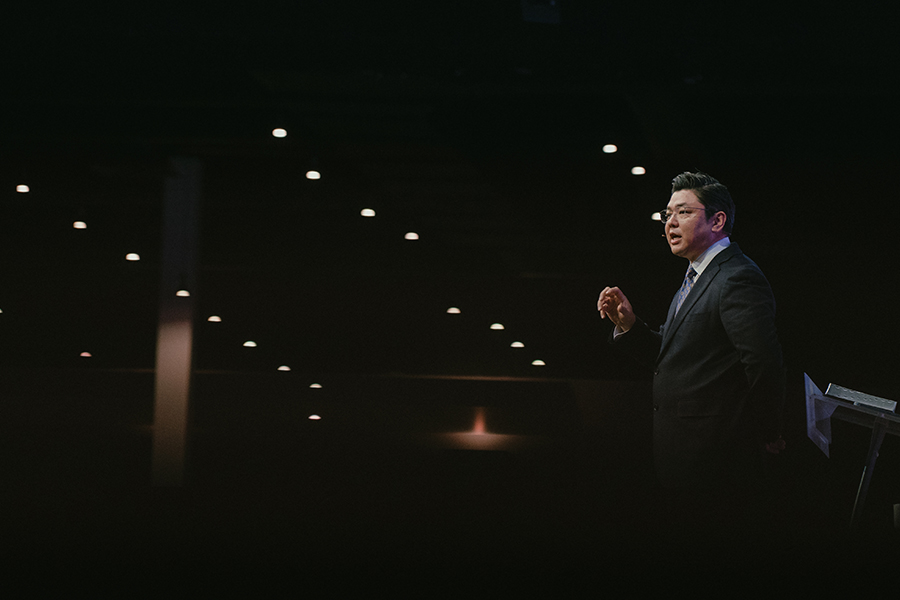
With this new desire, Lee took a study abroad program course at his school which was designed to prepare students for studying in either Korean or American colleges. He took standardized tests numerous times and achieved scores that led to his being accepted into schools in America such as Georgetown and UCLA. But Lee followed the advice of a counselor and went to Carleton College, a small but recognized liberal arts college in Minnesota. That small town provided the setting for God to draw Lee to Himself.
“That was a really, really lonely period,” Lee admits. But even in that time of loneliness, Lee says he had an encounter with God that drew him back to the calling to ministry.
Lee still held on to his vision of being a successful businessman, but with a renewed desire to serve a church as a deacon or elder. He returned to Korea after graduating and joined a business strategy team for the Samsung Economic Research Institute, reporting to the Samsung president and vice president.
He then transitioned to the financial sector as he worked in mergers and acquisitions for a Korean bank with a Merrill Lynch office, reaching the point where he was brokering deals between large corporations and the Korean government. His final deal was to be worth almost $10 billion, with Lee looking forward to a bonus worth millions. But it fell through just a couple days before it was to be finalized. This happened on the cusp of the 2008 economic downturn and Lee saw this as a good time to return to school and wait for the global economy to improve.
Just weeks later, Lee was in New York preparing to start a degree in East Asian regional studies at Columbia University. He recalls a defining day when he was riding a subway train through the city and noticed a front-page story of a newspaper announcing the company that had been in the deal he tried to facilitate in Korea had gone bankrupt. Just streets later, he saw employees of the same company, still wearing nametags, get on the public transportation carrying boxes holding their belongings from their offices.
“I felt a very weird feeling. … God was telling me that everything is collapsing like this,” Lee says of that moment. “Grass withers, flowers fade, and the Word of God stands forever, Isaiah 40:8. That verse hit me so hard, and I was like, ‘Yeah, everything collapsed.’”
That realization served as a reaffirmation of God’s call for Lee to pursue ministry.
“My mother’s vision in the hospital when I was young, when I got sick, now it’s my vision,” Lee says.
On that train, Lee decided that he would complete his master’s degree and then go right into seminary to prepare for the ministry to which God would call him to. But even before reaching that point, Lee says the business world began to pull at him again as former bosses, who were now in even higher positions in the financial world, began to recruit him personally.
“That was a point that really God tested me,” Lee says. “‘Do you really want to follow the Word of God, the mountain of the Word of God, or the mountain of success?’”
Despite others suggesting he was wasting those lucrative opportunities, or even that he was crazy for leaving the banking world that so many of his peers dreamed about being a part of, Lee says he remained focused on his goal of going to seminary.
And when he asked Billy Kim, who had prayed for him as an infant and who he still considered his pastor, what seminary he should attend, Lee says he did not hesitate in suggesting Southwestern. Lee graduated with his Master of Divinity in 2012, saying classes from Malcolm Yarnell, research professor of theology, and Roy J. Fish, legendary evangelism professor, lit a fire in him. Yarnell says he enjoyed having Lee in his classroom.
“He was always one of the most engaged students, both at the master’s and the doctoral levels,” Yarnell says. “One might say I learned as much from Ryan in the classroom and the seminar room as he learned from me. His queries were always perceptive, and he grew quickly to ask ever more important questions.”
Lee had an opportunity to serve in youth ministry at a church during his MDiv, and then was accepted into the PhD program at Southwestern. But he was surprised when his mentor Yarnell suggested a different path.
“All of a sudden, he told me, ‘I want you to leave our school, and I want you to be exposed to liberal theology,’” Lee says of Yarnell’s advice. “‘I know your story. … And in this generation, you need to know how to defend and advocate our theology to outside in the world. And I think you’re capable of doing that.’”
Yarnell says he is approached by students at times who are interested in following a path through Ivy League schools similar to his route of study, which took him to Duke and Oxford after completing his MDiv at Southwestern. Yarnell says he affirms that desire, but warns them “that in my experience, evangelicals who have pastoral experience are better prepared to handle that context.”
Lee was accepted at Harvard Divinity School and went there with a desire to be a “fighter for the Kingdom.” Lee completed his master’s degree and Yarnell says he returned “ready to help the many highly educated people in his own church face the challenges of our culture.”
In 2013, Lee entered a Southwestern cohort for his PhD in the new World Christian Studies program, with Yarnell as his supervisor.
“For all those seminary years, it’s not easy,” Lee admits of that time while he was studying and serving in ministry. “That’s the toughest kind of time, … but good, fun memories, and I met really good friends, colleagues at Southwestern.
“I would say you got to be moldable,” Lee says of seminary studies. “You got to be moldable, teachable at seminary. You can’t be like, ‘This is my theology. This is what I learned, so I’m doing it this way.’… Good seminaries make people moldable.”
Lee says that was a key difference between his time at the liberal divinity school and Southwestern. At Harvard, he says peers often wanted to argue what they had already learned in the past, taking a firm stance on established opinions and feelings. But through his focus on biblical languages during his MDiv and his love for hermeneutics, Lee says at Southwestern he learned how to better interpret the Bible in order to understand and then preach, like a lens that helps him read the Bible rightly.
“Southwestern gave me that lens,” Lee says, describing it as a “precious gift.”
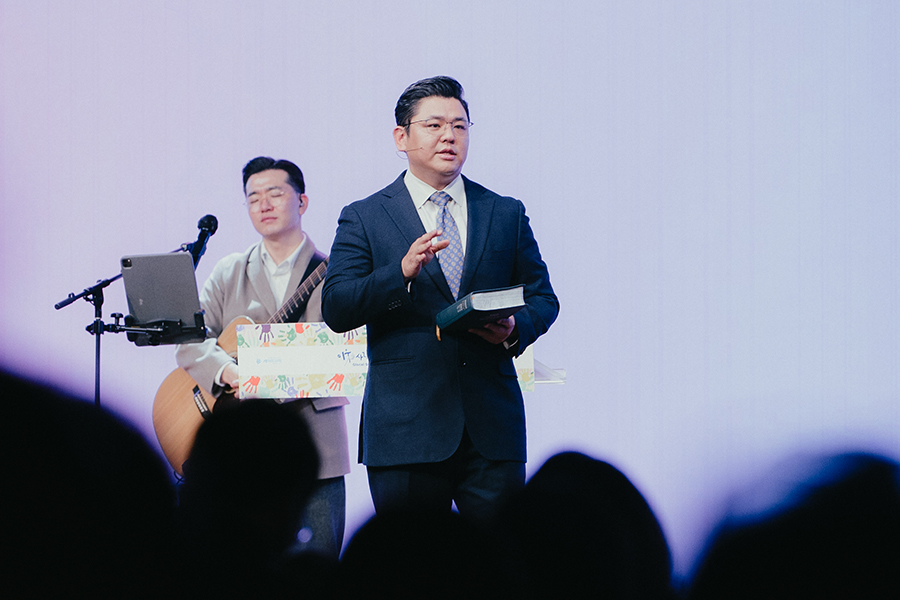
In 2018, just before Lee finished his PhD in 2019, the founding pastor of Semihan Church in Carrollton, Texas, a Korean church founded in 2000 that had grown to thousands of members, approached Lee about becoming his successor.
Lee accepted his first position as senior pastor at the immigrant and single-ethnic church, whose name is a combination of three Korean words that translate as world, America, Korea, emphasizing their desire to bring Christ to every nation.
Lee came to Semihan with his wife Sarah and their son and daughter, and no intention of redirecting the existing ministries of the church. He had heard of what is considered the four M’s in the life stages of a church: missions, ministry, maintenance, and museum. But Lee says their church added another stage to prevent the church from reaching that stagnant, museum stage—multiply.
As Semihan grew, Lee noticed that several members were now traveling great distances to be a member as Koreans moved to cities north of their location. So the congregation made the decision during the Covid pandemic to open a north campus in Frisco, meeting in a high school initially before a church building became available.
“Everybody thought I was crazy,” Lee says of the timing of that decision to multiply. “But I was confident that that was God’s calling. Ever since I’ve been a senior pastor here, really God gave me confirmation after confirmation.
“Our church members became one in spirit and one in vision—bring the world, America, Korea, to Jesus Christ.”
That unity would lead to a church planted in Houston and a multi-ethnic one in Frisco. In November 2025, Semihan also hosted its first WORLD conference, providing training to pastors in how to lead their churches to exhibit the characteristics of worship, fellowship, reaching out, being life-giving, and discipleship. The church also sends teams on mission trips nationally and internationally and has a program to provide skill development and employment opportunities to disabled individuals.
Amy Shin of Massachusetts first met Lee when he was serving as a college pastor at a church in Boston in 2013. She became a Southwestern student at his suggestion, completing a Master of Divinity in international church planting degree in the 2+2 program. She now serves on staff at Semihan Church.
“Dr. Lee has been my pastor for the past 13 years, and in these 13 years, I have had the privilege to be part of his congregation as a layperson, to being part of his lay leadership team, to now being a part of his staff at Semihan Church,” Shin says. “Throughout the years, I have seen this man evolve in ways that have grown him as a shepherd, as an evangelist, and as a preacher. But the things that have always stayed consistent are his love for Jesus, his love for God’s people, and his loyalty to the church. … I am forever grateful to call this man of God my pastor and I believe he will continue to lead Semihan Church in obedience to our Lord Who was and is and is to come.”
In April of 2025, Lee was named a recipient of the Southwestern Distinguished Alumni Award. He is a member of the Southwestern Board of Reference and the Semihan Church partners with the seminary through annual student scholarships.
“Ryan Lee is a gifted preacher, a caring pastor, an entrepreneurial leader, a thoughtful theologian, and a committed follower of Christ,” Southwestern President David S. Dockery says. “We are grateful for his ongoing friendship to and partnership with Southwestern as well as his commitment to Southwestern students.”
Lee encourages other alumni, churches, and believers to consider financially supporting seminary students as well, even immigrants and ethnic minorities such as at Semihan, as a way to give back to their alma mater or to invest in future pastors for the “Kingdom’s sake.”
“If you want better equipped pastors, you have to see better equipped seminarians,” Lee says. “In order to see better equipped seminarians, you have to sponsor and support seminaries. It’s easy logic. As a senior pastor, I want to see more equipped, better equipped pastors. If you want to see better equipped pastors, to plant other churches and regenerate our church, then you got to see well equipped seminarians, well equipped seminaries. You got to support and invest.”


