McKinney’s ‘German Protestant Church Struggle’ focuses on how churches responded to the Third Reich

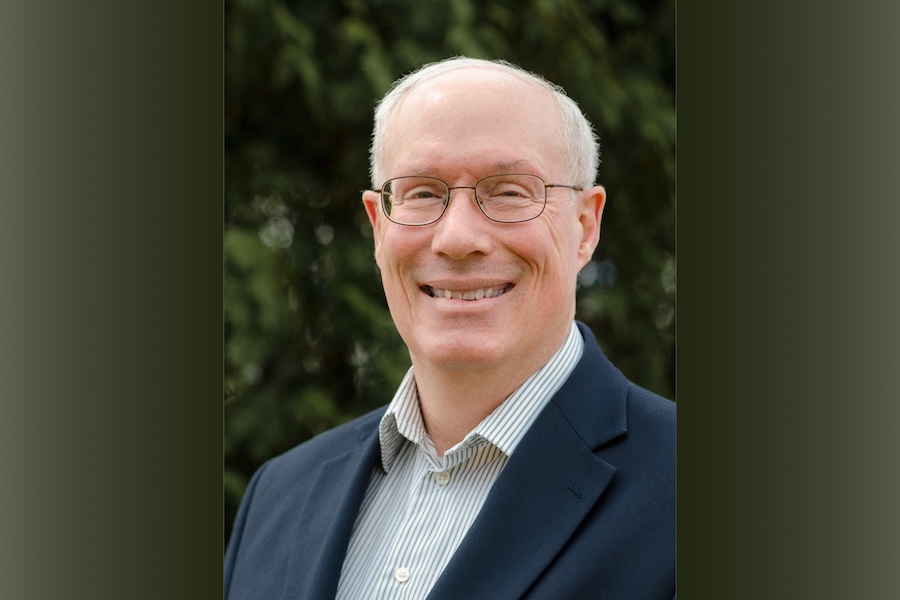
Blake McKinney, assistant professor of history and humanities at Southwestern Baptist Theological Seminary, discussed his recently published book, German Protestant Church Struggle: Toward a New History, during a book talk hosted by the Land Center for Cultural Engagement and the School of Theology on Oct. 22.
McKinney said it was only natural that he become interested specifically in the history surrounding Germany and World War II, as both his grandfathers fought in that war and his great aunt was German who grew up under the Third Reich and told him stories about that era. He lived in Germany one summer and his dissertation at the University of Alabama was titled “The National and International Church: National Socialism, German Protestantism, and the Watching World.”
His newest book, published by Fortress Press and released Oct. 20, focuses on the German and international Protestant church from 1933 to 1937, as the Nazi Party began to establish itself. At that time, McKinney said Germany was still recovering from the First World War, the Spanish Flu, the stock market crash in the United States, and economic devastation and inflation as a result.
“There’s national shame, there’s economic uncertainty, there’s all these things going on,” McKinney described Germany in the mid-1930s. “And then here comes this group that knows how to put on a really good mass program, can look really sharp in their uniforms, and they can promise a restoration of morality and conservative values and a good economy.”
And so, the Nazi Party with Adolf Hitler at its head stepped in. McKinney said even Protestants, mostly consisting of Lutherans and reformed individuals with some Baptists and Methodists, believed in the promises made by Hitler at first. While a few individuals like Dietrich Bonhoeffer were opposed from the beginning, most were like theologian Martin Niemoller, who voted for the Nazis but within six months became a voice against the party.
“Hindsight is 20/20,” McKinney said. “We know… that World War II is happening in 1939, and the Holocaust is coming. We know all of that, but the historical actors did not.”
While the government would move against Christians later, McKinney explained in those early years Christians were trying to figure out what to do in the confusion. Most Christians were not revolutionaries but were focused on the purity within the church, protecting it against the German focus on nationalism and growing antisemitism and the attempt to create the Reich church.
But McKinney said believers today need to be on guard against criticizing Christians in Germany or around the world for not responding to Hitler’s actions sooner. He pointed out that even with today’s technology, Christians are not always aware of the severity of actions being taken against the church around the world.
“One of the things to consider in all this is rarely does life give you a sharp choice of ‘This is the defining moment. Do this, be courageous now,’” McKinney said. “For so many people they only see it in hindsight totally. They’re only able to see it years later and go, ‘I should have turned there.’”
McKinney said the focus of his book is to not just the churches in Germany, but the churches around the world and how they were responding during that time. In his studies of the rhetoric of the British and German Baptists, he pointed out that much of their terminology and language was the same, but the national context led many Germans to wrong conclusions.
“We can’t see our blind spots on our own,” said McKinney, urging humility among Christians when considering what other believers are saying. “Our blind spots are shown to us by others.”
He also said he wanted his work to give a clear chronology of events and written works during that time, not jumping between different years and themes since changes occurred quickly over a short span of years.
The book can be purchased on Amazon or other places where books are sold.