
Malcolm Yarnell’s ‘God,’ ‘Word’ provide trinitarian theology for every person
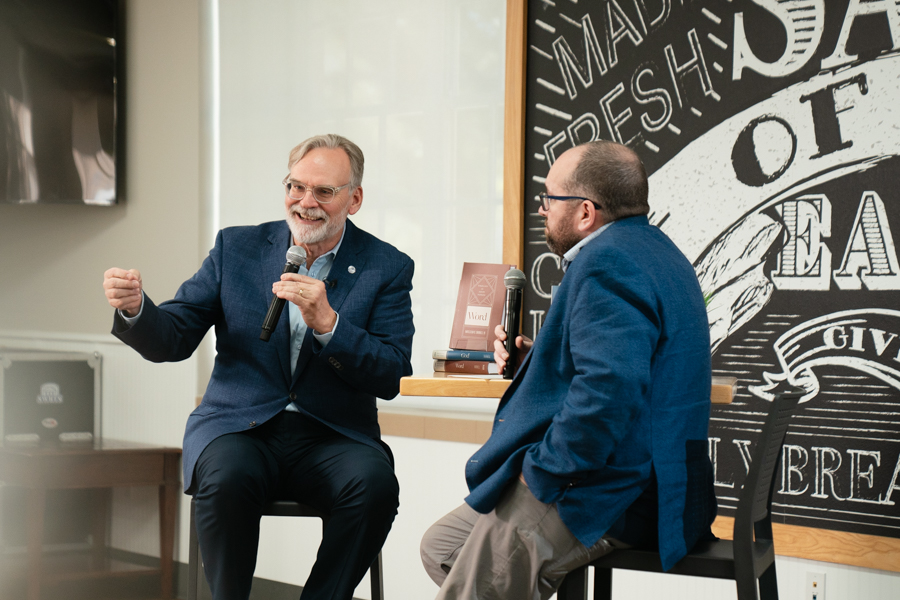
Malcolm Yarnell, research professor of theology at Southwestern Baptist Theological Seminary, discussed his current writing project, the Theology for Every Person trilogy, that includes God and his recently published work Word during the Faculty Book Talk hosted by the School of Theology and the Land Center for Cultural Engagement on Nov. 12.
Yarnell said it was while pursuing his Master of Divinity at Southwestern with the goal of teaching, that God impressed on him that “if I’m going to be an effective teacher of ministers, of missionaries, of worship leaders, then I need to have walked where they will be walking,” explaining that systematic theology is demonstrated in the practice of the local church.
Recognizing that truth led to his desire to bring theology not just to the classroom but to churches.
“The belief in the priesthood of all believers, that all of us are responsible for proclaiming the light of Jesus to the world, is what has compelled the whole project,” Yarnell said. “What made it more important to me is that, as I had discussions with people in the local churches, I discovered that theology in the local church is not necessarily a common thing, and yet Jesus commanded us to love the Lord our God with all of our heart, soul, mind, and strength.”
Yarnell said sometimes church members shy away from theology because of a misunderstanding of what it is, but Yarnell said theology is simply the study of God and should be desirable to every believer because of their love for God and calling to tell others about Him.
Unfortunately, Yarnell said a recent George Barna study revealed that only 16 percent of American Evangelicals could be truly classified as trinitarian. But he added that he has recently seen a greater interest in theology among pastors.
“Teaching the doctrine of the trinity is important from the perspective of knowing Who the one true God is, as opposed to false alternatives. It’s also important to understand who God the Trinity is because God saves you in His trinitary works,” he said, explaining that the Father sent the Son to become flesh and to die for mankind, and also sent the Spirit to convict people of that truth, “Who then through faith regenerates us, so that we can believe and be born again.”
The first book of the trilogy, God, was released by B&H Publishing in 2024 and focuses on the theology of the person of God the Father in the trinity. Yarnell said having a correct understanding of God is crucial for salvation, but that recent surveys and studies show that many professing evangelicals see no difference between the God of the Bible and that of Islam, for example.
“I think that we have settled into the idea that if somebody believes in ‘God,’ they’re okay,” Yarnell said. “And that comes out of our apologetic to try to convince people that there is a God, which I think is necessary. But there are many false views of God as well.”
The second book, Word, released in 2026, Yarnell said focuses on Jesus as the Word mentioned in the Gospel of John, Who is both fully human and fully divine, present with God at the time of creation but also identified as God, an attribute of the second person of the trinity that is beyond human understanding.
“There is a mystery to who God is, and there is also going to be a mystery to who the Word is,” Yarnell said, but added there is enough revelation in Scripture to give a picture of Jesus as the means of salvation for anyone who confesses that He is Lord.
“At the center of the Christian faith is Christ,” Yarnell said. “And if Christ is not at the center of our faith, our affections, our practice, we’re going to go astray.”
Yarnell said he continues to work on the forthcoming third book, Spirit, which concludes the series.
“I want to encourage pastors and church leaders to get these books and distribute them,” said Dan Darling, assistant professor of faith and culture and director of the Land Center, who hosted the book discussion, adding the book is helpful for “people who may not be seminary trained or may not be interacting with theology like we do. These are really written for them and accessible so they can understand God and understand the personal work of Christ.”


